
FDM 3D Printing Bristol
Engineering Grade FDM Services – Bristol
Over five decades of expertise
Serving the whole of Bristol
Unwavering commitment to quality
Engineering Grade FDM 3D Printing in Bristol: Empowering Defence and Aerospace Innovation
Bristol, a hub of advanced engineering and technological innovation, is increasingly leveraging the power of industrial FDM (Fused Deposition Modelling) 3D printing. At Malcolm Nicholls Ltd, we bring over 50 years of prototyping expertise directly to Bristol, offering high-performance FDM services that are critical for mission-critical applications in the defence and aerospace sectors.
Our industrial FDM capabilities provide a reliable and repeatable additive manufacturing process, delivering high-strength, functional parts using the same advanced thermoplastics trusted in traditional manufacturing. From rapid prototyping to low-volume production and complex tooling, FDM offers unparalleled advantages for Bristol’s demanding industries.
Our 3D Printing Services
Beyond FDM, Malcolm Nicholls Ltd offers a comprehensive suite of advanced 3D printing and manufacturing technologies. This includes Stereolithography (SLA) for incredibly fine detail and smooth surface finishes, and Selective Laser Sintering (SLS), renowned for producing strong, functional parts from powdered nylon. We also provide Low Volume Production services such as vacuum casting, allowing us to bridge the gap between prototyping and mass production with a wide choice of materials.
SLA
Stereolithography (SLA) also often referred to as SLA is the most widely used resin 3D printing technology. it is generally considered to provide the greatest accuracy and best surface finish of any prototyping or 3D printing process.SLS
SLS can build functional parts, casting patterns and tooling inserts from your 3D CAD data. Our HiQ Sinterstation system (SLS 3D Printing machine) represents the future of Instant Manufacturing Technology.FDM
Manufacturing FDM known as fused deposition modelling is the most widely available form of 3d printing. It is an additive manufacturing technology that selectively deposits molten plastic to build parts layer by layer.Large Format
As a leading UK 3D printing service, we provide large format SLA 3D printers with their impressive build platforms of 800 x 800 x 600mm.Transparent
We can produce large transparent 3D printing without the need for sectioning and fabricating back together, by utilising our large format SLA 3D printers.Carbon
Carbon has proven itself for its reliability in the toughest of environments, whether your looking to use it in low volume production or rapid prototyping Carbon 3D Printing is a great option.Engineering Grade FDM Materials for Extreme Environments
Our extensive selection of industrial FDM materials is specifically chosen to meet the rigorous demands of defence and aerospace applications. Key materials include:
- ULTEM™ 9085: A high-performance thermoplastic with an exceptional strength-to-weight ratio, ideal for aerospace, automotive, and rail applications. It is FST-rated (Flame, Smoke, and Toxicity), offers excellent thermal and chemical resistance, and is lightweight and durable for functional prototypes and end-use parts. Certified-grade options ensure traceability for regulated industries.
- ULTEM™ 1010: Boasting the highest heat resistance of any FDM material (HDT of 216°C), ULTEM™ 1010 provides excellent chemical resistance and mechanical strength. Its autoclave compatibility makes it ideal for medical, aerospace, and food-grade applications, with certified grades available for biocompatibility and food contact.
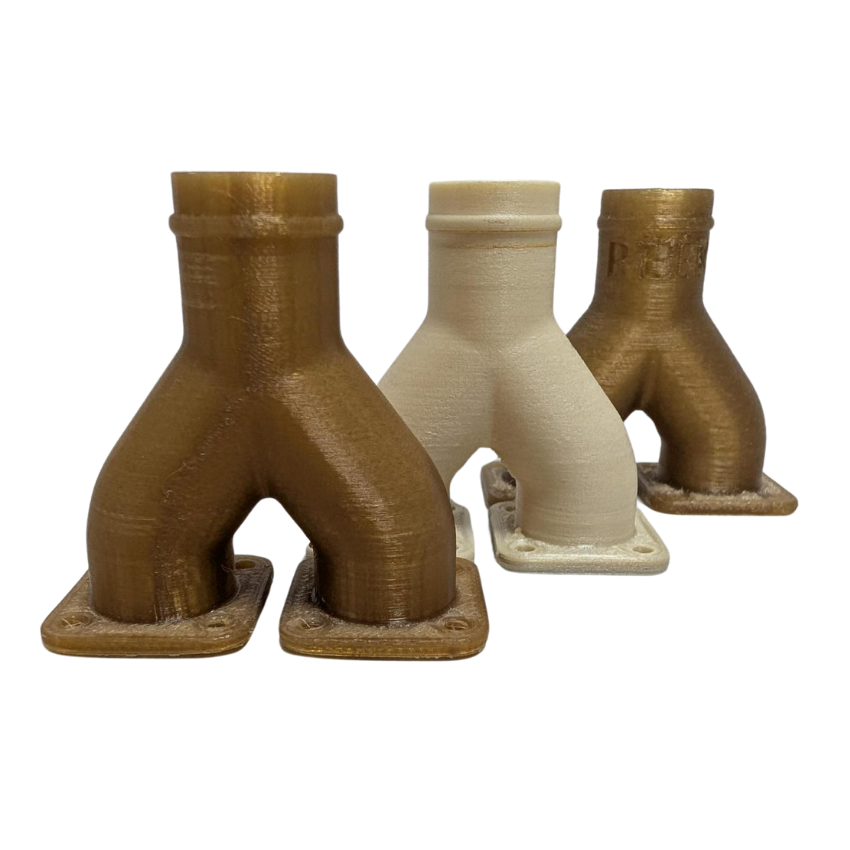
- PEEK: This material offers exceptional mechanical strength and stiffness, comparable to metals, making it ideal for demanding engineering applications. With a continuous use temperature up to 260°C, excellent chemical resistance, and natural flame-retardancy, PEEK is perfect for engine components, aerospace fixtures, and medical implants.
- PEKK: Offering greater thermal stability and lower melt temperature than PEEK, PEKK provides superior layer adhesion for better isotropic mechanical properties. Its outstanding dimensional stability, low outgassing, and high resistance to wear, fatigue, and chemicals make it ideal for aerospace, satellite, and space-bound components.
- PPSU (Polyphenylsulfone): With higher impact strength and temperature resistance than PSU and PES (up to ~220°C), PPSU offers outstanding chemical resistance, even to aggressive disinfectants. Its high toughness and flame resistance are invaluable for aerospace, automotive, and healthcare applications, and it retains mechanical properties after repeated autoclave cycles.
- Nylon 12CF (Carbon-Fiber Filled Nylon 12): Carbon fiber reinforcement significantly increases stiffness, strength, and dimensional stability, offering an excellent strength-to-weight ratio. This makes it a lightweight alternative to metal for tooling and structural parts, providing best-in-class performance for load-bearing applications.
These materials, combined with our flexible nozzle options (0.2mm to 1.2mm) and high-temperature printing capabilities (up to 500°C), ensure we can produce parts with exceptional strength, thermal resistance, and chemical stability.
How it works
Upload your files
For unfinished, straight-off-the-printer 3D parts, upload your 3D CAD files and get an instant quote.
For larger projects where quotes for multiple parts are needed, get in touch.
Get your quote
Get your online instant quote for straight off the printer 3D printing, or for more intricate/complex projects our technical team will be on hand to quote you.
Printing starts
From our 3D printing facility near Birmingham, we start producing the parts immediately.
Every single item is quality-checked by our engineers before heading out for delivery.
Delivery/ Collection
Our intricate 3D printed parts can be produced in days, even hours for smaller projects and delivered with our secure couriers.
Prefer pickup? Our headquarters are in Bidford-on-Avon, just contact us ahead to arrange a collection time.
FDM in Defence & Aerospace: Strengthening Capabilities
Bristol’s defence and aerospace sectors are at the forefront of leveraging FDM 3D printing to produce robust, lightweight components with significantly reduced lead times. For critical applications where performance, rapid deployment, and adherence to stringent industry standards are paramount, FDM offers transformative advantages
- Functional Field Components & Lightweight Structural Elements: FDM enables the rapid production of durable components for tactical equipment, drone parts, and test rigs for defence, while in aerospace, it’s used for non-critical structural elements like brackets, ducts, and interior panels, often achieving substantial weight savings over traditional methods.
- Rapid Design Iteration & Prototyping: The ability to quickly print and test prototypes of weapon systems, communication devices, military vehicles, and aircraft components accelerates development cycles. This allows engineers to iterate designs quickly, assess form, fit, and function, and make informed decisions earlier, ensuring solutions are battlefield-ready faster and meet stringent aerospace specifications.
- On-Demand Manufacturing & Supply Chain Resilience: FDM supports the creation of custom parts on demand, reducing reliance on lengthy, vulnerable supply chains. This is critical for ensuring that mission-critical equipment remains operational in defence, even in remote or combat zones, and provides immediate availability for spare parts in aerospace, reducing aircraft downtime.
- Custom Tooling and Fixtures: Both sectors benefit from FDM’s ability to produce highly specific manufacturing aids. This includes inspection fixtures, drill jigs, masking templates, and composite mold tooling, which can be rapidly produced to reduce manufacturing costs and accelerate assembly processes.
- Complex Geometries and Part Consolidation: FDM offers unparalleled design freedom, allowing for intricate designs and the consolidation of multiple parts into a single component. This not only reduces weight and assembly time but also enhances performance by enabling features impossible with traditional manufacturing methods.
- Flame-Retardant and High-Performance Materials: The availability of advanced thermoplastics like ULTEM™ 9085 and PEKK, which offer high strength-to-weight ratios, excellent thermal and chemical resistance, and flame, smoke, and toxicity (FST) ratings, is crucial for producing flight-approved parts and components for demanding defence environments.
Case Studies
See how Malcolm Nicholls has helped other businesses like yours
Looking for prices?
Ready to start your vacuum casting project? Share your project details and data with our team of experts, and we’ll be happy to assist you at every step.